
Mapping tells Spark Shipping which vendor supplies each product in your store and what that vendor calls it. A bulk mapping file handles a lot of products at once: one CSV per vendor, one row per product.
If you only have a few products to map, it's quicker to do them from the product page. See SKU Mapping - Single.
Build the file
Start from the Basic SKUs template. You can also download it from the SKU Mapping page. It has two columns:
- ProductSku: the SKU in your store. It's the first column on the Products page.
- VendorSku: what the vendor calls the product, usually their SKU or part number. Spark Shipping sends this value on orders and looks for it in the vendor's inventory feed.
Add one row per product, and make a separate file for each vendor. A finished file looks like this:
ProductSku,VendorSku
1066421,1066421
SPARK-1066420--SHIP,1066420
If you sell under the vendor's own SKU, both columns are the same, like the first row above. Some vendors use their own internal ID instead of the part number. Turn 14 is the usual one, and it has its own walkthrough: Turn14 Bulk SKU Mapping.
Save the file as a CSV. If your SKUs start with zeros, Excel may strip them when you save. Missing Leading Zeros When Mapping SKUs shows how to keep them.
Upload it
- Go to Vendors, click the vendor, then click SKU Mapping in the left menu.
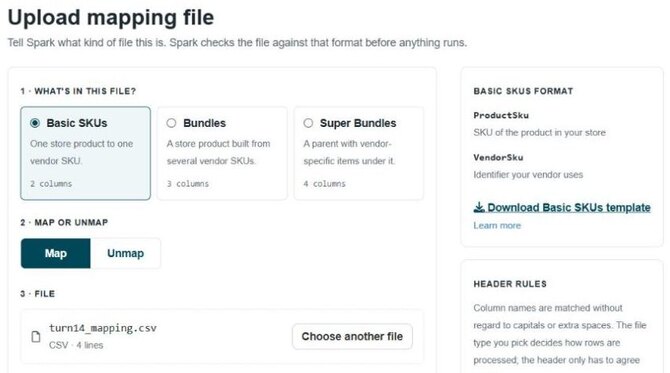
- Under What's in this file?, choose Basic SKUs.
- Leave Map selected.
- Click Choose file and pick your CSV, or drag the file onto the box.
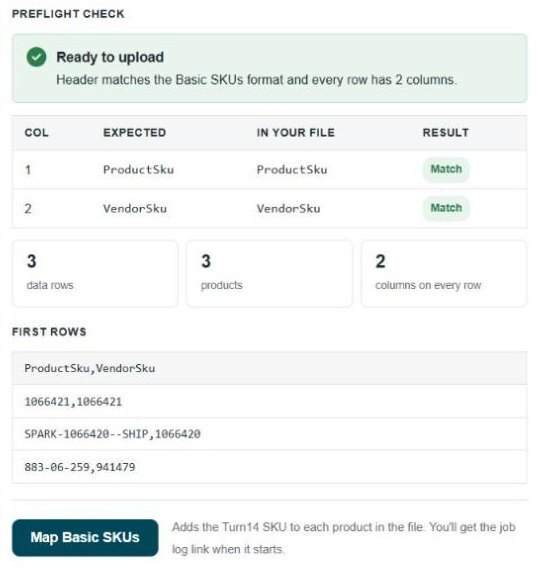
Before anything runs, Spark Shipping reads the file and shows a Preflight check. It compares your header to the expected columns, counts the rows and products, and shows the first few lines so you can confirm it's the right file. When it says Ready to upload, click Map Basic SKUs.
The job starts right away, and the page gives you a link to its job log. Large files take longer to finish, so give it some time before you check the products.
When the preflight check blocks the upload
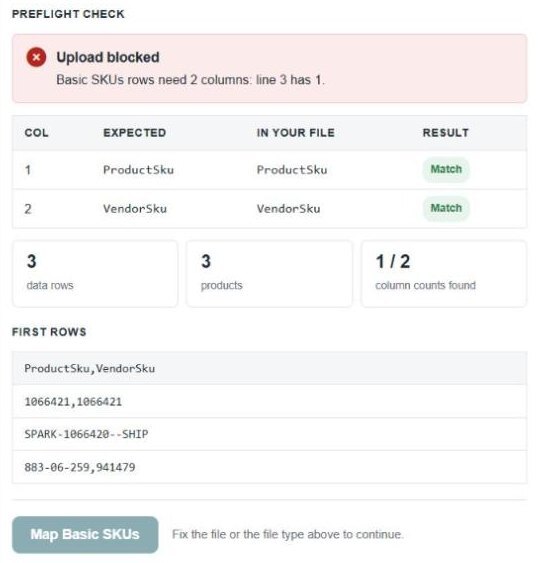
The button stays grey until the file matches the file type you picked. Two things cause most blocks.
A row is missing a column. The check names the line, for example "line 3 has 1." Every row needs both columns. A cell can be empty, but it still needs its comma.
The file is a different type. If your file has a BundleQuantity column, Spark Shipping reads it as a Bundles file, and a four-column file reads as Super Bundles. The check tells you which type it found and offers to switch. Only switch if that's what you meant to upload.
Header names don't have to match exactly. "Product SKU" or "vendor sku" gets corrected to the expected spelling, and the check tells you it did. But if your first row doesn't look like a ProductSku and VendorSku header at all, Spark Shipping decides the file has no header, reads the columns by position, and treats that first row like any other product. If you start from the template, this won't come up.
Check the results
Open the job log from the link on the SKU Mapping page, or find it under the vendor's Jobs. A line like "Product 12345 not found in site. Skipping" means that ProductSku doesn't match anything in your store. Check it against the Products page, character for character.
To see what mapped, open the vendor's Products page. Each mapped product shows up with its vendor SKU beside it.
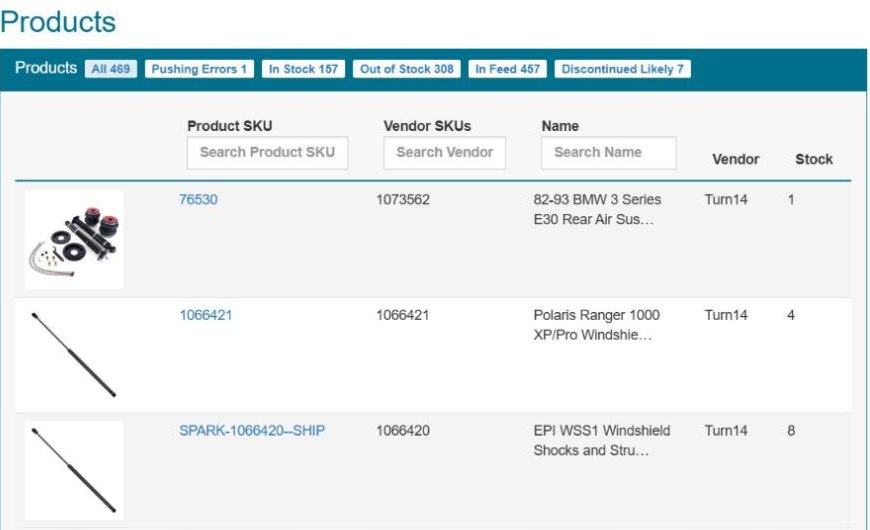
When a product maps but never picks up stock or cost, the VendorSku usually doesn't match the vendor's feed. It's usually a missing prefix or dropped leading zeros, and now and then a stray space. Troubleshooting SKU Mapping Errors covers the fixes.
Good to know
- Uploading another file doesn't remove existing mappings. Products in the new file get mapped or updated, and everything else stays as it was.
- A product can be mapped to more than one vendor. Upload a file to each one.
- To take products off a vendor, use Unmap on the same page. See Unmapping SKUs.
- Bundles use a three-column file. See Creating Product Bundles.