
1. Ensure your products' SKUs are correctly mapped to the vendor's. The CSV mapping file should contain no errors, such as duplicate entries, typos, etc. Mapping instructions can be found here.

2. If you're using a built-in vendor, navigate to Advanced on the left side navigation menu. For custom vendors, find the 'Inventory' section and click on 'New Inventory Update'.

3. Prepare the inventory file, make sure it contains no errors, i.e duplicate entries, typos, etc.. Next, select the inventory strategy as 'Manual Upload' > Select the File Type (CSV, Excel XLS or XLSX, XML, EDI 846, ZIP...) > Save Inventory Settings. Proceed with uploading a sample file under Sample Inventory File, and click Save Inventory Settings.
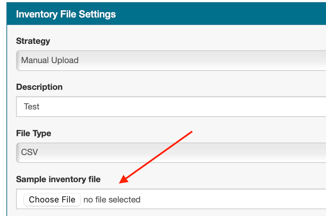
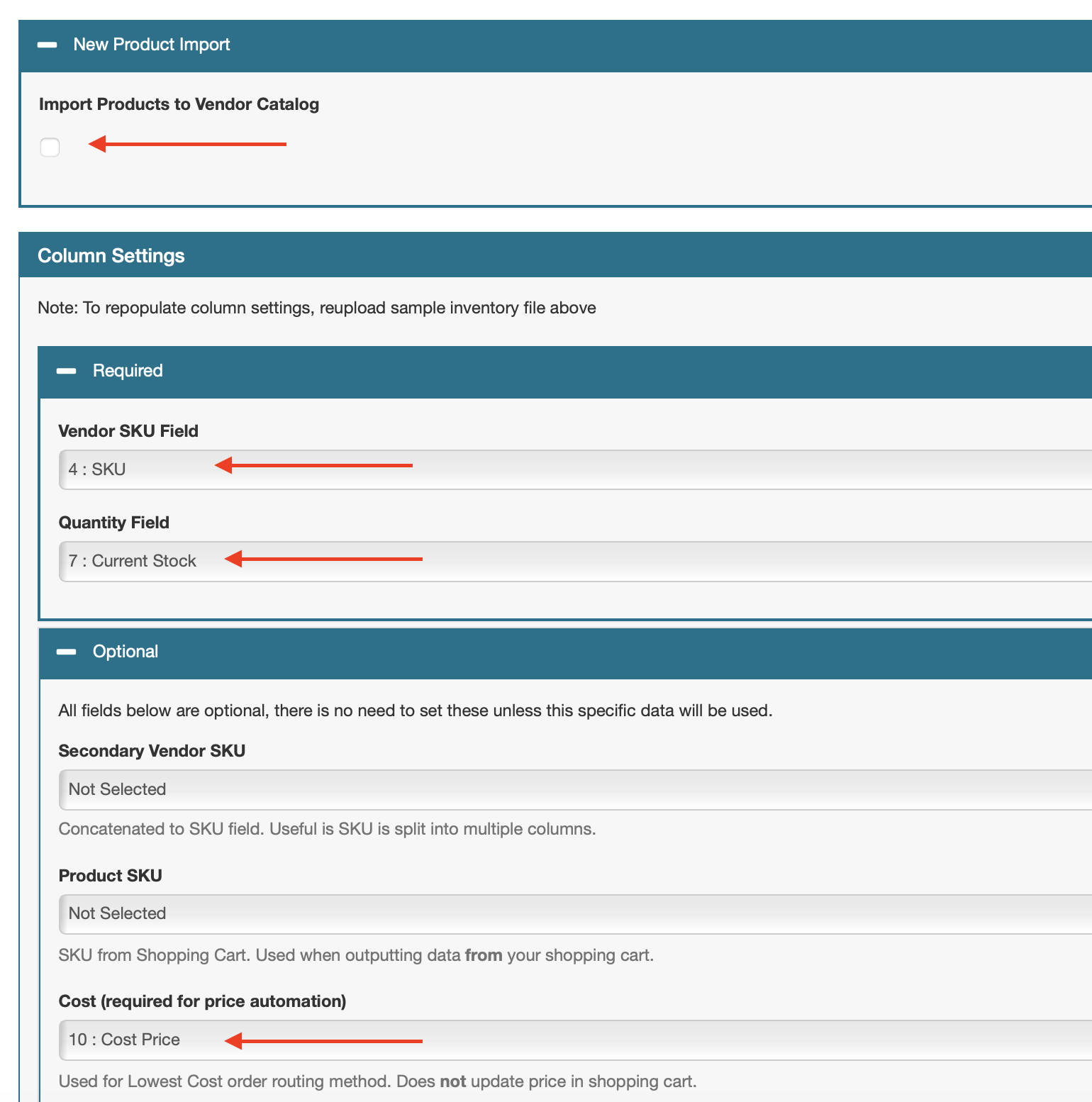
Next, wait for the system to parse your sample file and understand its format (may take a few seconds up to a minute depending on your sample file size) > You will then be presented with the columns settings. Next step is to map the columns and update the settings.
Important: If you wish to create a product catalog out of this manually uploaded file, make sure you check the box "Import Products to Vendor Catalog"
4. Upload the inventory file manually.
** For Emailed Feeds, click on 'Upload Inventory' and find the unique email address that Spark Shipping generated for this inventory template. You can share this email address with your vendor to have them email the file directly to Spark Shipping to have the inventory automatically update in your store. Emailed feeds are treated exactly as manually uploaded feeds, they will be processed when the email is received. If you need a different address, click Assign new email.

Inventory Settings Notes:
- The delimiter field should be the separator that is used in the inventory file. Delimiters can be commas, semicolons, pipe delimiters.. etc.
- Setting 'Update Inventory Quantity in Shopping Cart' to Update local and remote will push the inventory update from your vendor's feed to your shopping cart. Update local only updates Spark Shipping without pushing to your cart, and No updates (disabled) turns quantity updates off.
- Setting a number for 'Stock Maximum' caps the quantity Spark Shipping sends to your shopping cart: any vendor quantity higher than this number is sent as this number. If the quantity at the vendor feed falls below this number, Spark Shipping will push the actual quantity to your shopping cart. Because capped quantities stop changing, this helps reduce the number of API calls made to your site.
- Setting a number for 'Stock Minimum' will make Spark Shipping set the quantity as 0 in your shopping cart if the quantity falls below this number in your vendor's feed. This helps avoid overselling a product.
- 'Default Quantity' is used when the vendor sends a quantity that is not a number.
- Checking 'Assume 0 inventory for mapped SKUs missing from the feed' treats a mapped SKU that is not in the file as out of stock, instead of keeping its last quantity.
- 'Max % of in-stock SKUs that can be set to 0 per run' protects you from an incomplete file. If a run would set more than this share of your in-stock SKUs to 0, those updates are skipped for that run and noted in the vendor's log. Leave it blank to use the default (50%), or enter 100 to turn the limit off.